How many solar panels does your home need?
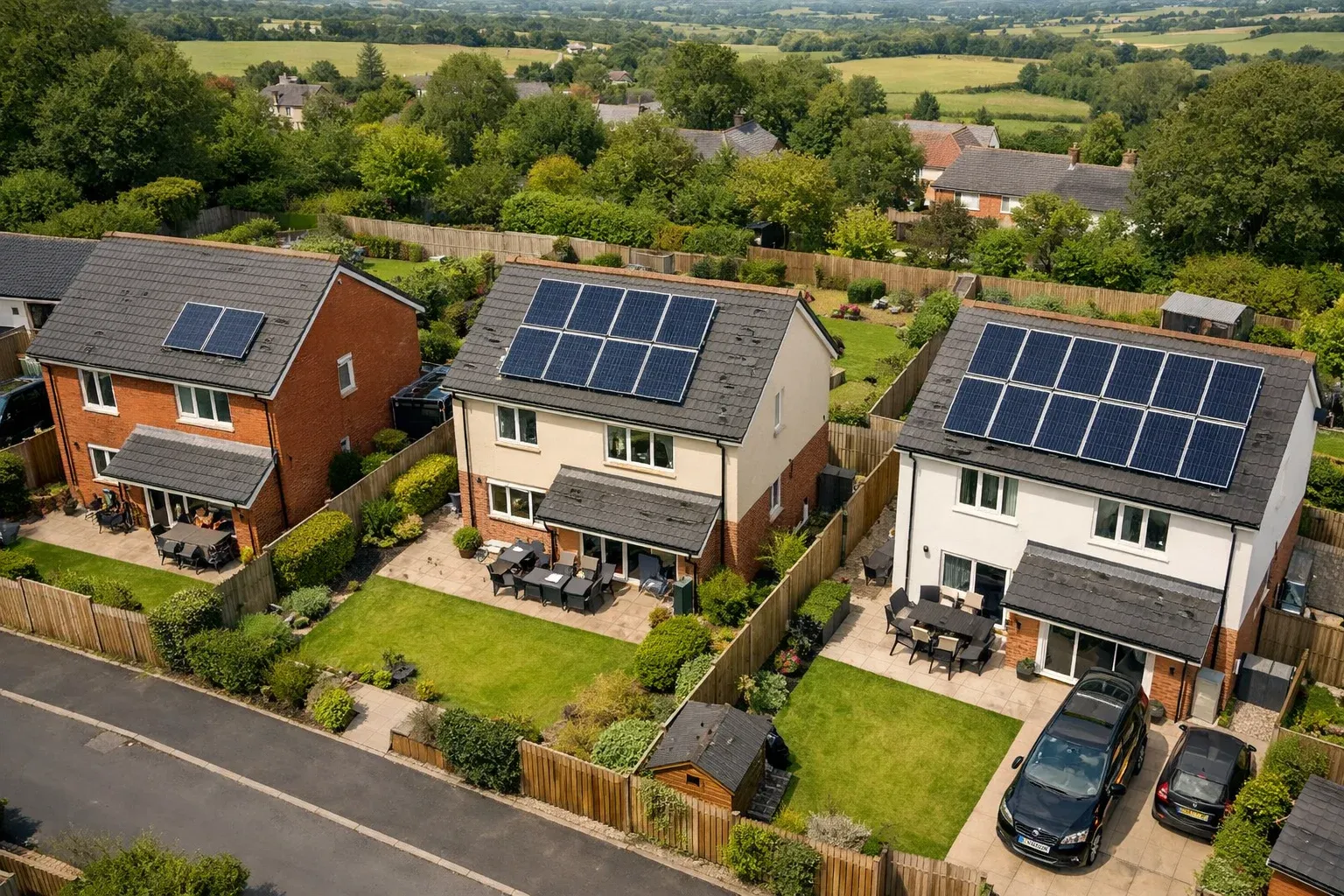
To determine the right number of solar panels for your home, you need to assess your household's energy consumption, evaluate your roof's suitability, and consider the efficiency of various panel types. The average UK home uses around 2,500 kWh of electricity annually1, which serves as a key starting point for calculating your solar panel requirements. However, the actual output of solar panels can vary significantly based on factors such as panel efficiency, roof orientation, shading, and local weather conditions.
Calculating your current electricity usage
The first step in determining your solar panel requirements is to understand how much electricity your household consumes. Your energy bills are the most accurate source for this information, typically showing your usage in kilowatt-hours (kWh) over a month or quarter. The average UK home uses approximately 2,500 kWh of electricity annually, which translates to roughly 6.8 kWh per day or 208 kWh per month. This figure provides a useful benchmark, but your actual usage may vary significantly based on your lifestyle, the number of occupants, and the energy efficiency of your appliances.
Estimating future energy demands
When planning a solar panel system, it is crucial to consider not just your current energy use but also any anticipated increases in demand. Future additions like an electric vehicle (EV) charger, a heat pump, or even an increase in household size can significantly alter your electricity consumption. For instance, charging an EV could add thousands of kWh to your annual usage, while a heat pump, though highly efficient, will still draw electricity. Factoring these into your calculations ensures your solar system remains adequate for your needs over time.
Key factors influencing solar panel quantity
Several critical factors influence the number of solar panels your home will need. Ignoring these can lead to an incorrectly sized system that either fails to meet your energy demands or overproduces, leading to a less efficient investment.
Solar panel efficiency and wattage
Modern residential solar panels typically have a power output ranging from 250W to 450W, with many popular models around 350W to 400W. The wattage indicates how much electricity a single panel can generate under ideal conditions. Higher-wattage panels produce more power per panel, meaning you might need fewer panels to achieve your desired output. Panel efficiency, which measures how much sunlight is converted into electricity, also plays a significant role; more efficient panels can generate more power from a smaller area.
Available roof space and orientation
Your roof's characteristics are paramount. A south-facing roof with an optimal pitch (around 30-40 degrees in the UK) receives the most direct sunlight throughout the day, maximising generation. East or west-facing roofs can still be effective but may produce around 15-20% less energy. North-facing roofs are generally unsuitable for solar panels. The physical size of your roof also dictates how many panels can be installed; each panel requires approximately 1.5 to 2 square metres of space. Shading from trees, chimneys, or neighbouring buildings can drastically reduce a panel's output, so a clear, unshaded area is ideal.
Local sunlight hours and shading
The amount of sunlight your property receives throughout the year directly impacts solar panel performance. While the UK has fewer peak sunlight hours compared to sunnier climates, solar panels still generate substantial electricity. However, local weather patterns, seasonal variations, and any persistent shading will affect the actual output. A detailed site assessment by an installer will account for these local conditions.
Budget and system goals
Your budget will naturally influence the size and type of solar system you can install. Beyond the initial cost, consider your primary goals: do you aim for complete energy independence, or simply wish to reduce your electricity bills? If your goal is to reduce reliance on the grid, you might opt for a larger system with battery storage. If it is purely about lowering bills, a smaller system might suffice.
Estimating your solar panel requirements
Once you understand your energy consumption and the factors affecting panel performance, you can begin to estimate your specific solar panel needs.
Matching generation to consumption
The ideal scenario is to size your solar system to match your annual electricity consumption. For example, if your home uses 2,500 kWh per year, you will want a system that can generate a similar amount. A 4 kW system, for instance, can cover a significant portion of an average household's demand. However, due to variations in sunlight and usage patterns, you will still draw electricity from the grid, especially during evenings and winter months.
Common system sizes and panel counts
Most UK homes install solar systems ranging from 3 kW to 6 kW. To estimate the number of panels for a given system size, divide the desired system size (in watts) by the wattage of an individual panel. For example, a 4 kW (4,000W) system using 400W panels would require 10 panels (4000W / 400W = 10 panels).
| System Size (kW) | Approximate Panels (400W each) |
|---|---|
| 3 kW | 7-8 |
| 4 kW | 10 |
| 5 kW | 12-13 |
Note: These are approximations. Actual generation varies based on location, orientation, shading, and panel efficiency.
The role of battery storage
Integrating battery storage with your solar panels significantly enhances your system's effectiveness. Batteries store any surplus electricity generated during the day, allowing you to use it during the evening or at other times when your panels are not producing. This increases your self-consumption, reducing your reliance on grid electricity and further lowering your energy bills. A battery can significantly increase how much of your solar generation you actually use.
Maximising your solar investment post-installation
Installing solar panels is a significant step towards energy independence, but the true value comes from optimising their output and managing your energy effectively.
Understanding the Smart Export Guarantee
The Smart Export Guarantee (SEG) is a government-backed initiative that requires certain licensed electricity suppliers to pay small-scale generators for the low-carbon electricity they export to the National Grid. This means you can earn money for any surplus electricity your solar panels generate and send back to the grid. SEG tariffs vary between suppliers, so it is worth comparing rates to ensure you get the best return on your exported energy.
Smart energy management with the Fuse app
Once your solar panels are installed, smart energy management becomes key to maximising your savings. The Fuse app provides tools to monitor your solar generation and consumption, helping you make informed decisions about your energy use. By understanding when your panels are producing the most electricity and how much you are using, you can adjust your habits to align with your generation.
Optimising self-consumption and export
To get the most out of your solar panels, prioritise self-consumption. This means using as much of the electricity you generate as possible within your home, rather than exporting it. For example, run appliances like washing machines or dishwashers during peak sunlight hours. Any remaining surplus can then be exported to the grid via the SEG, or stored in a battery for later use. This dual approach of maximising self-consumption and benefiting from SEG ensures you get the most value from your solar investment.
Next steps for UK homeowners
Embarking on your solar journey involves careful planning and choosing the right partners.
Consulting certified solar installers
For solar panel installation, it is highly recommended to consult with MCS (Microgeneration Certification Scheme) and TrustMark certified installers. MCS certification ensures your installer meets strict standards for safety, workmanship, product quality, and consumer protection. It is also a requirement for registering for SEG payments. TrustMark is a government-endorsed quality scheme that provides additional assurance of high standards and customer protection. These certifications give you confidence that your system will be installed correctly and safely.
Choosing the right energy supplier for solar homes
After installation, selecting an energy supplier that offers smart energy management tools is crucial. Fuse Energy supports homeowners in maximising their solar investment by providing tools and insights through the Fuse app to help monitor and control solar-generated energy. This approach helps reduce reliance on grid imports and gives you more 'power to play with' from your solar panels.
References
Disclaimer
For the avoidance of doubt, this article is provided for informational purposes only and is not intended to constitute legal or financial advice. The author and/or Fuse Energy shall not be responsible for any losses arising out of any reliance on the information contained herein.