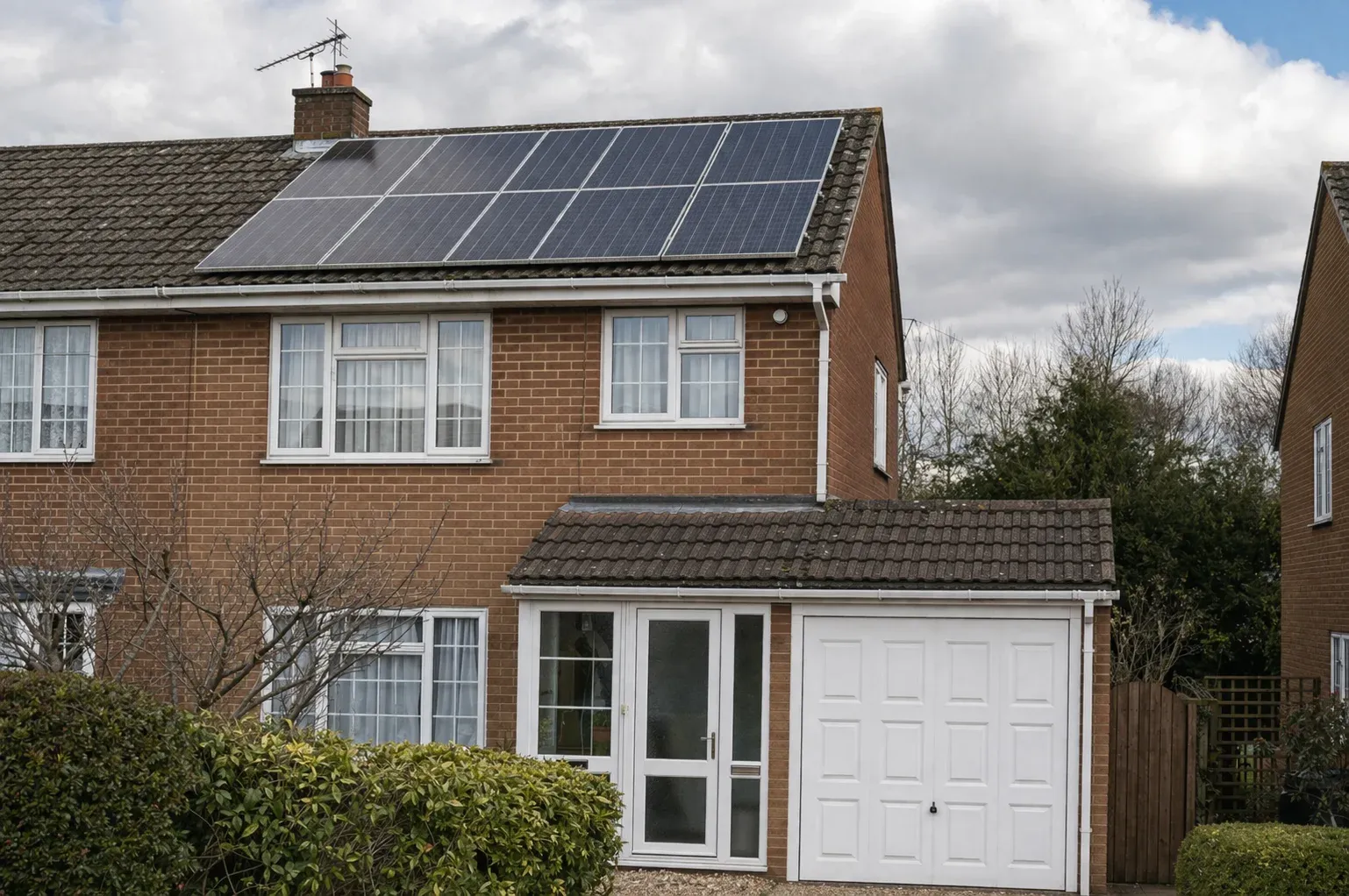
Solar panels convert daylight into electricity for your home, reducing reliance on the grid and cutting energy bills. For many UK homeowners, understanding how this technology functions - especially with our often-cloudy weather - is the first step towards a more sustainable and cost-effective energy future.
The science behind solar panels
At their core, solar panels harness a fundamental physical process to generate electricity.
Understanding the photovoltaic effect
Solar panels operate through the photovoltaic (PV) effect, a process discovered in 1839 by Edmond Becquerel. When light strikes the semiconductor material, typically silicon, within a solar cell, it energises electrons. These excited electrons are then freed from their atoms, creating an electric current. This movement of electrons is electricity.
From sunlight to direct current
The electricity generated directly by solar panels is direct current (DC). DC electricity flows in one direction, much like the power from a battery. However, most household appliances and the national electricity grid operate on alternating current (AC). This means an essential conversion step is needed before your home can use the solar-generated power.
Key components of a home solar system
A complete home solar system involves more than just the panels themselves. Several components work together to convert sunlight into usable electricity for your property.
Solar panels
These are the most visible part of the system, typically installed on your roof. Each panel contains multiple photovoltaic cells that capture sunlight and initiate the electricity generation process.
Inverters
The inverter is a crucial piece of equipment, often located in your loft, garage, or utility space. Its primary function is to convert the direct current (DC) electricity produced by your solar panels into alternating current (AC) electricity, which is the standard for your home's appliances and the National Grid. Some systems use micro-inverters on each panel for individual panel optimisation.
Mounting systems
Mounting systems securely fix the solar panels to your roof or other structures. They are designed to suit various roof types and angles, ensuring the panels are optimally positioned to capture sunlight while withstanding UK weather conditions.
Optional: battery storage
While not strictly necessary for a functioning solar system, battery storage allows you to store excess electricity generated during the day for use later, such as in the evenings or on cloudy days. This can significantly increase your self-consumption of solar energy.
How solar electricity powers your home
Once installed, your solar system integrates directly with your home's electrical supply.
Converting DC to AC for household use
After the panels generate DC electricity, the inverter steps in to transform it into AC. This AC power then flows to your home's consumer unit (fuse box), ready to power your lights, appliances, and other electrical devices.
Real-time energy consumption
When your solar panels are generating electricity, your home will automatically use this free, self-generated power first. This reduces the amount of electricity you need to draw from the National Grid, directly lowering your energy consumption from your supplier.
What happens to excess solar energy?
Often, your solar panels will generate more electricity than your home is using at that exact moment. This surplus energy doesn't go to waste.
Storing energy in a home battery
If you have a home battery, any excess solar electricity that your home doesn't immediately use can be stored there. This stored energy can then be used later, for example, at night when your panels aren't generating, or during periods of low generation. This helps you maximise your self-consumption and further reduce reliance on grid electricity.
Exporting to the National Grid
For homes without battery storage, or when your battery is full, any surplus electricity is automatically exported back to the National Grid. Under the Smart Export Guarantee (SEG) scheme, energy suppliers pay you for this exported electricity. This creates an additional financial benefit from your solar system.
How solar panels affect your electric bill
Solar panels can significantly reduce your electricity bill. By generating your own power, you buy less from your energy supplier. The more of your own solar electricity you use, the greater your savings. Payments received through the SEG for exported energy also contribute to reducing your overall bill.
How much electricity does an average UK home use per year?
The average UK home uses around 2,500 kilowatt-hours (kWh) of electricity per year. This figure, set by Ofgem, serves as a benchmark for typical domestic consumption, though actual usage varies based on household size and habits.
Solar panels in the UK climate
A common concern for UK homeowners is whether solar panels are effective given our climate. The answer is a resounding yes.
Performance on cloudy days
Solar panels generate electricity from light, not heat. This means they still work on cloudy or overcast days by capturing diffused sunlight that filters through the clouds. While their output will be lower than on a bright, sunny day, they continue to produce electricity. On heavily overcast days, output might drop to 10-25% of their normal capacity, but they are still contributing to your energy supply.
Addressing night-time operation
Solar panels require sunlight to generate electricity, so they do not produce power at night. During these hours, your home will either draw electricity from a connected battery storage system (if you have one) or from the National Grid. This seamless switch ensures your home always has power.
Year-round efficiency
Despite shorter daylight hours and often grey skies, solar panels remain a viable renewable energy source in the UK. Cooler temperatures, common in the UK, can actually improve the efficiency of PV cells, as high temperatures can reduce performance. A typical 4kW domestic solar system in the UK can generate between 3,400 and 4,200 kWh of electricity per year, covering a significant portion of a household's annual demand.
Maximising your home's solar potential
Getting solar panels is just the beginning; optimising their output can lead to even greater savings and energy independence.
Optimising self-consumption
The most financially beneficial way to use your solar energy is to consume it directly within your home. This is known as self-consumption. Running appliances like washing machines or dishwashers during daylight hours when your panels are generating can significantly reduce the amount of electricity you need to import from the grid. Battery storage further enhances this by allowing you to use your self-generated power even when the sun isn't shining.
Smart energy management with Fuse Energy
Understanding and optimising your energy flow is where Fuse Energy comes in. While Fuse Energy does not install solar panels, it plays a crucial role in integrating home solar generation into a smarter, more efficient energy system. Fuse's app provides real-time insights into your home's energy usage and solar generation, helping you understand and optimise your energy flow. Through smart tariffs and intelligent energy management tools, Fuse helps homeowners make the most of their self-generated power, contributing to an abundant energy future.
For the avoidance of doubt, this article is provided for informational purposes only and is not intended to constitute legal or financial advice. The author and/or Fuse Energy shall not be responsible for any losses arising out of any reliance on the information contained herein.