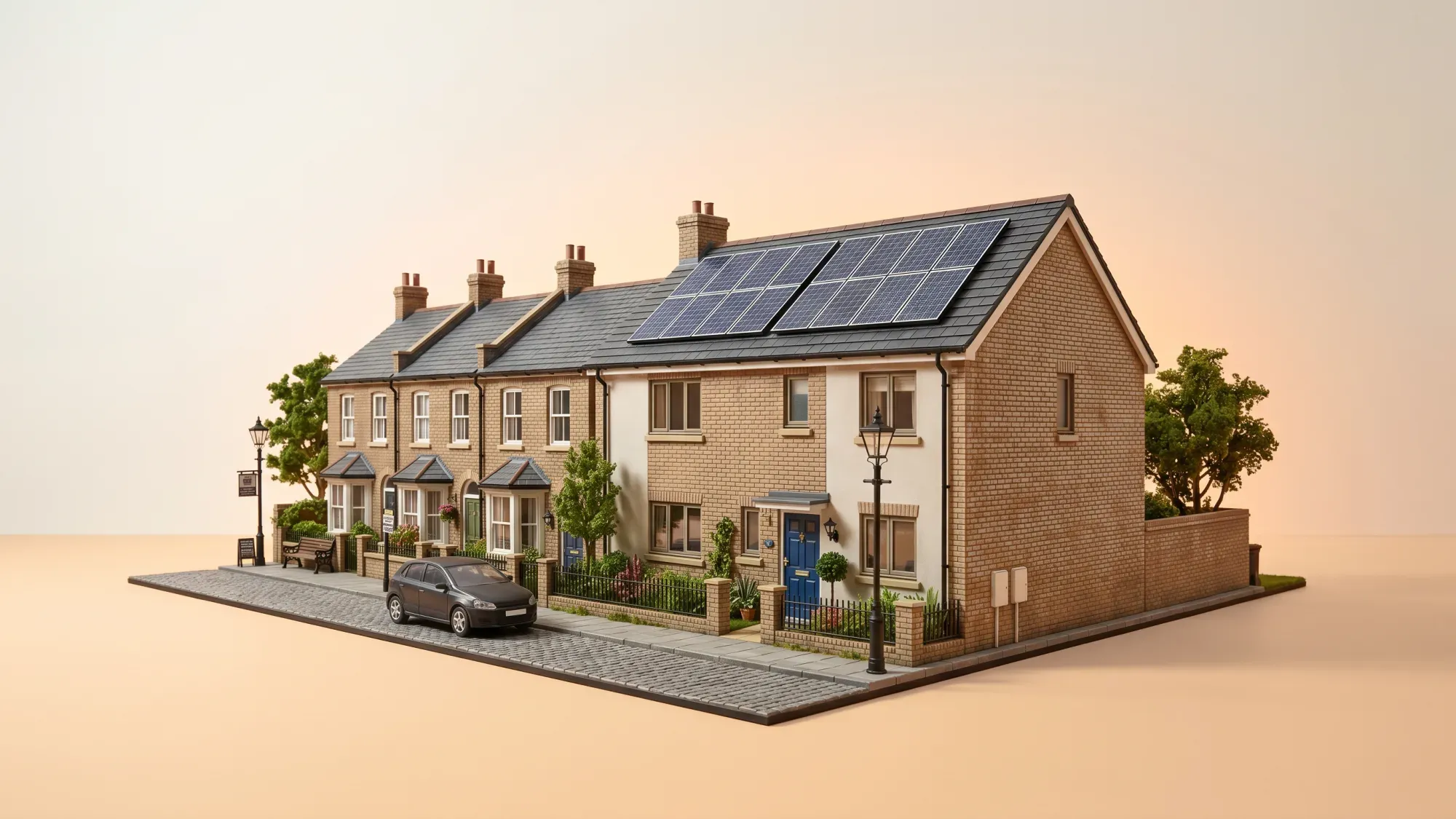
Most UK homeowners do not need planning permission to install solar panels on their homes. This is thanks to "permitted development" rights, which simplify the process for many residential installations. However, there are crucial conditions and exceptions you need to understand to avoid potential issues. Getting it wrong could mean having to remove your system at your own expense.
Understanding solar panel planning permission in the UK
Installing solar panels is a significant step towards a more sustainable home, but navigating the legal requirements can seem daunting. The good news is that the UK planning system is designed to encourage renewable energy adoption, making the process straightforward for the majority.
The basics of permitted development rights
In England and Wales, the installation of solar panels on your home is typically considered "permitted development". This means you generally do not need to apply to your local council for planning permission. These rights are set out in The Town and Country Planning (General Permitted Development) (England) Order 2015. They exist to streamline improvements, including solar panel installation, provided your project meets specific conditions regarding size, position and visual impact.
When planning permission is usually required
While most installations fall under permitted development, there are specific scenarios where full planning permission, or other consents, become necessary. These include properties that are listed buildings, those located within a conservation area, or if you plan to install ground-mounted solar panels that exceed certain limits. Additionally, if your proposed installation does not meet all the permitted development criteria, you will need to submit a planning application.
Permitted development rights for roof-mounted solar panels
For roof-mounted solar panels, permitted development rights apply to most houses and flats, provided certain conditions are met.
Conditions for permitted development
To qualify as permitted development, solar panels must be sited, as far as practicable, to minimise their effect on the external appearance of the building and the amenity of the area. They should also be removed as soon as reasonably practicable when no longer needed.
Size and projection limitations
A key condition for roof-mounted solar panels is their projection from the roof surface. On a pitched roof, panels should not be installed above the highest part of the roof (excluding the chimney) and must not project more than 200mm from the roof slope or wall surface. For flat roofs, regulations were relaxed in December 2023, allowing panels to extend up to 600mm above the roofline without requiring planning permission. Panels on a flat roof must also be at least 1 metre from the edge of the roof.
Solar panels in conservation areas and on listed buildings
Properties with special designations, such as those in conservation areas or listed buildings, have stricter planning rules.
Conservation area solar panel rules
You can install solar panels in a conservation area, but with restrictions. While permitted development rights often still apply, panels must not be fitted to a wall that faces a highway. This includes roads, footpaths and public rights of way. If your roof faces away from the road, roof-mounted panels are generally fine under permitted development.
Some conservation areas are subject to an Article 4 Direction. These directions, issued by local planning authorities, remove specific permitted development rights, meaning you would need to apply for full planning permission.
What is an Article 4 Direction?
An Article 4 Direction is a legal order issued by a local planning authority that removes specific permitted development rights in a defined area, such as a conservation area. If one covers solar panels, you will need to apply for full planning permission for work that would otherwise be permitted.
Listed building Consent for PV panels
If your property is a listed building, any external alteration, including the installation of solar panels, typically requires Listed Building Consent (LBC). This is because listed buildings are protected for their historical or architectural significance, and any changes must preserve their character. You will need to apply to your local planning authority and demonstrate how the solar panel system will affect the building's character, ensuring the installation does not harm its special interest. Some listed buildings may not be suitable for solar panels if the only practical position is a prominent roof slope.
Checking your property's status
Before planning any solar installation, it is crucial to check if your property is a listed building or located within a conservation area. You can usually do this through your local council's website, which often provides interactive maps or searchable databases. For listed buildings, you can search the National Heritage List for England (NHLE) via Historic England's website. For conservation areas in England, you can also use GOV.UK's planning data map or Defra's MAGIC map.
Planning permission for ground-mounted solar panels
Ground-mounted solar panels follow different rules from rooftop systems, as they affect land use and visibility.
General requirements for ground-mounted systems
Ground-mounted solar panels generally require planning permission. However, a single ground-mounted array may be permitted development if it meets certain conditions:
It covers no more than 9 square metres in area.
It is no higher than 4 metres.
It is positioned at least 5 metres from the property boundary.
It is the first such installation on the property; any additional ground-mounted solar installations beyond the first one will require planning permission.
In a conservation area or World Heritage Site, ground-mounted panels must not be visible from the road.
Agricultural solar panel considerations
For agricultural solar panels, roof-mounted systems on existing farm buildings in England often qualify as permitted development. This is usually the simpler route from a planning perspective. However, ground-mounted agricultural solar panels require more consideration and typically need full planning permission, especially for large-scale systems or those exceeding a certain size. The planning rules depend on the size of the system, the land classification and the intended use of the electricity generated.
Navigating the planning application process
If your solar panel installation does not meet permitted development criteria, you will need to apply for planning permission.
Consulting your local planning authority
When in doubt about specific conditions or requirements, always consult your local planning authority (LPA). They can provide clarity on local regulations, including any Article 4 Directions that might apply to your area. This proactive step can save you time and prevent costly mistakes.
What to include in your application
A planning application typically requires detailed documentation, including site drawings and illustrations of where the panels will be installed and what they will look like. You will need to explain how the installation will fit with its surroundings and minimise visual impact. The application process can take 8-13 weeks for most residential solar projects.
Key takeaways for your solar installation
Understanding the planning rules for solar panels is essential for a smooth installation process.
Ensuring compliance and avoiding pitfalls
To ensure compliance and avoid common pitfalls:
Check your property's status: Confirm if it is a listed building or in a conservation area early on.
Adhere to permitted development conditions: Pay close attention to panel size, projection limits and placement.
Consult your LPA: When in doubt, contact your local council for guidance.
Plan ground-mounted systems carefully: These often require planning permission due to size and location.
By following these steps, you can confidently navigate the planning requirements for your solar panel installation in the UK.
Next steps after planning approval
Once you have secured any necessary planning approvals or consents, you can proceed with your solar panel installation.
For the avoidance of doubt, this article is provided for informational purposes only and is not intended to constitute legal or financial advice. The author and/or Fuse Energy shall not be responsible for any losses arising out of any reliance on the information contained herein.