Business solar panels: costs and benefits
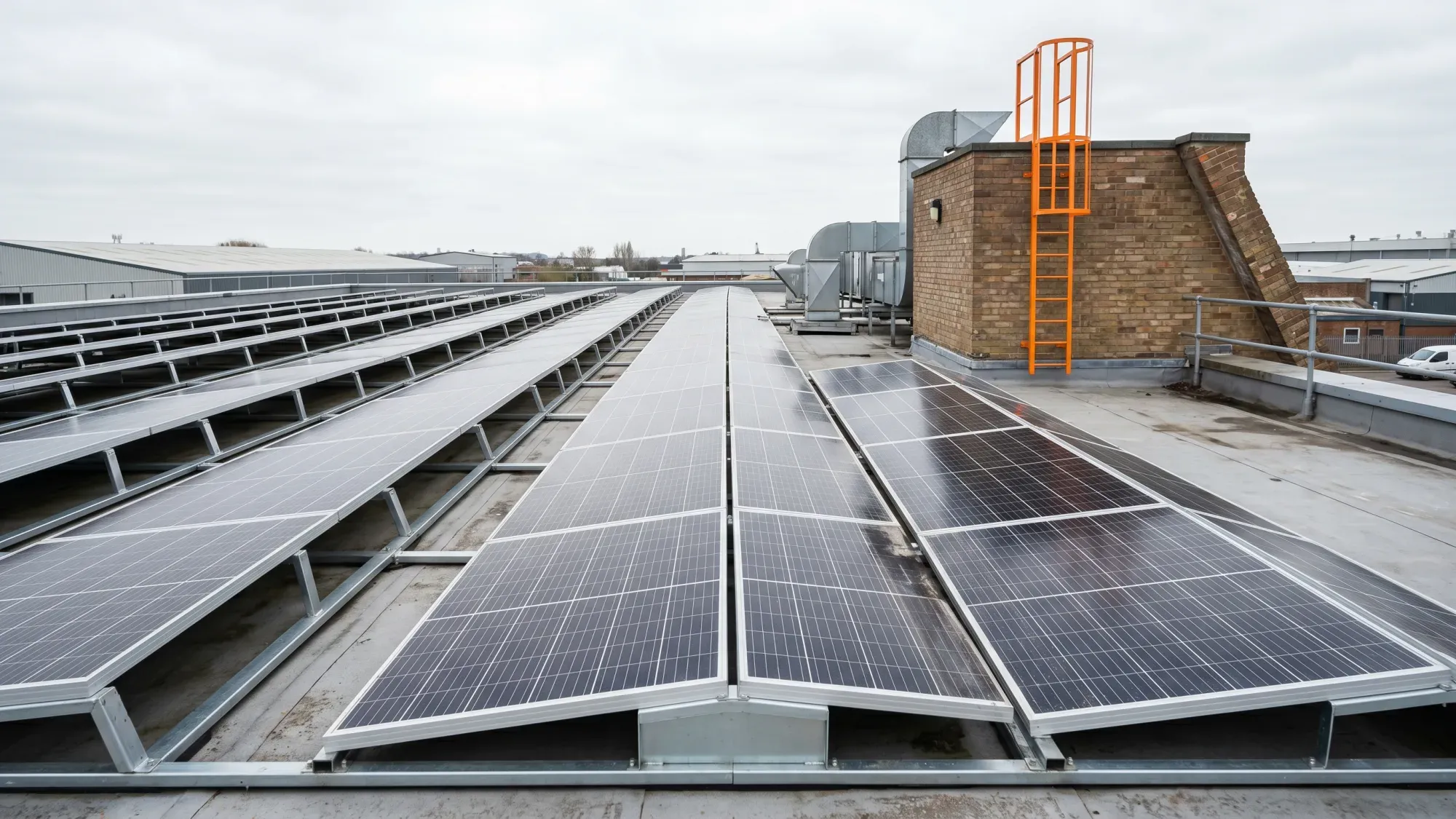
Investing in business solar panels can transform an operation, offering a strategic advantage in a dynamic energy market. This guide provides clear information on the benefits, costs and practical steps involved in installing solar panels, empowering business owners and facility managers to make informed decisions for their operations.
Why consider commercial solar panels for your business?
Commercial solar panels are more than an environmental statement; they are a robust investment that enhances a business's financial health, operational resilience and public image.
Reducing operating costs and energy bills
Generating your own electricity significantly reduces reliance on grid power, leading to substantial savings on energy bills. Businesses with high energy usage, such as factories, warehouses and data centres, often experience faster returns on investment as they consume more of the electricity generated on-site. Commercial electricity rates in the UK have seen significant increases, with prices in Q1 2026 averaging around 24p per kWh, approximately 60% higher than in 2021. By generating their own power, companies can lock in long-term energy rates and protect themselves from market fluctuations and future price spikes.
Enhancing sustainability and brand image
Adopting solar energy enhances a business's environmental credentials, aligning with corporate social responsibility goals and attracting eco-conscious customers. This commitment to sustainability can also differentiate a business in the market and improve public relations.
Achieving energy independence and resilience
Solar photovoltaic (PV) systems provide businesses with greater energy independence, reducing reliance on the National Grid. This can be particularly valuable during periods of grid instability or power outages, ensuring operational continuity. With a solar energy system and battery storage, businesses can ensure they have energy reserves to call upon and can switch between stored energy and the grid depending on electricity costs.
Leveraging the Smart Export Guarantee (SEG)
The Smart Export Guarantee (SEG) is a UK government initiative that allows businesses to receive payments for any surplus electricity they export back to the National Grid. This provides an additional revenue stream and enhances the return on investment for solar installations. Larger energy suppliers (those with more than 250,000 domestic electricity customers) are mandated to offer SEG tariffs, while smaller suppliers may join voluntarily. SEG tariffs vary between suppliers, but all must offer a rate above zero. You can learn more about the scheme in our guide to what is the SEG.
Understanding the cost of commercial solar panels
The upfront investment for commercial solar panels can vary significantly, but understanding the factors influencing these costs and the potential for return is crucial.
Factors influencing installation costs
The cost of commercial solar panel installation varies based on system size, complexity and site-specific requirements. In 2026, fully installed commercial solar panels typically cost between £660 and £1,200 per kilowatt (kW). Larger systems often benefit from economies of scale, meaning the cost per kW can be lower for bigger projects. For example, a 50kWp system might cost around £45,000-£60,000, while a 100kWp system could range from £75,000-£95,000 before tax relief. Key cost components typically include the panels (25-30%), inverters (10-15%), mounting systems (10-15%), electrical components and labour (25-35%), and additional costs like grid connection and planning applications (15-20%).
Typical payback periods and return on investment
Commercial solar panel systems typically have a payback period of 5-10 years. However, some businesses, particularly those with high energy usage, can see returns in as little as 3-5 years. The average return on investment (ROI) for commercial solar systems typically falls between 8% and 14%, with some businesses achieving 16% - 45% ROI. After the initial payback, systems can generate profit for 15-20+ years.
What is the typical lifespan of commercial solar panels?
Commercial solar panels are generally built to last 25 to 30 years, with many systems continuing to generate electricity beyond this timeframe. Most high-quality panels are warrantied to still produce at least 80% to 85% of their original power output after 25 years.
Operational and maintenance expenses
While solar panels are known for their durability, ongoing maintenance is necessary to maximise efficiency and extend their lifespan. Annual solar panel maintenance typically costs between £100 and £300, covering inspections, cleaning and minor repairs. Professional cleaning is generally recommended every 12-18 months, costing between £20 and £200 per cleaning for commercial arrays. Inverters, a key component, typically need replacing after 10-15 years, with a budget of around £1,500-£3,000 for replacement.
UK grants, incentives and financing for business solar
Several government incentives and financing options can significantly improve the viability and return on investment for commercial solar installations in the UK.
Capital allowances and tax reliefs
Businesses can claim 100% first-year capital allowances on qualifying plant and machinery investments, including commercial solar PV systems, reducing their taxable profits. The Annual Investment Allowance (AIA) allows businesses to deduct the full cost of solar installations, up to £1 million per year, from their taxable profits. This means that for every £1,000 invested, a business could save up to £250 in corporation tax, assuming a 25% corporation tax rate. If annual expenditure exceeds the £1 million AIA limit, additional investments may qualify for a 50% First Year Allowance (FYA) in the first year, with the remaining balance written down at 6% annually.
Rooftop solar installations in England are also exempt from business rates until 31 March 2035, which can be a significant saving for larger premises.
Local authority and regional funding opportunities
While there isn't a general government grant for commercial solar panels, local authorities and regional bodies may offer specific funding opportunities. Businesses should investigate local programmes that support renewable energy adoption or energy efficiency improvements.
Power Purchase Agreements (PPAs) and lease options
For businesses that prefer to avoid the upfront capital outlay, Power Purchase Agreements (PPAs) and lease options offer alternative financing solutions. Under a PPA, a third party invests in, installs and maintains the solar panels, selling the generated electricity back to the business at a fixed or discounted rate. This allows businesses to benefit from solar energy without the initial investment, though it may reduce the overall ROI compared to outright ownership due to finance charges.
The commercial solar panel installation process
Installing commercial solar panels involves a structured process, from initial assessment to ongoing maintenance.
Initial site assessment and energy audit
The first step is to assess your business's energy consumption and the suitability of your site for solar. This involves a thorough energy audit to understand your usage patterns and a site survey to evaluate roof space, orientation, shading and structural integrity. This ensures the system is appropriately sized and designed to meet your specific needs. Considering energy efficiency tips can also help optimise your overall energy strategy.
System design and quotation
Based on the assessment, a detailed system design will be developed, outlining the number and type of panels, inverters and mounting systems. You should obtain detailed quotes from Microgeneration Certification Scheme (MCS) certified commercial solar installers to compare costs, proposed designs and warranties.
Planning permission and grid connection
Most commercial rooftop solar installations do not require full planning permission due to permitted development rights. However, strict conditions apply, such as panels not extending more than 200mm beyond the roof surface. Full planning permission is typically required for installations on listed buildings, in conservation areas (if visible from a public road), or for larger ground-mounted systems.
Connecting your solar panels to the National Grid requires approval from your Distribution Network Operator (DNO). This usually involves submitting applications under technical standards like G98 (for smaller systems up to 3.68kW per phase) or G99 (for larger installations). The DNO may require network upgrades, which can add to the project's cost and timeline.
Installation, commissioning and handover
Once all approvals are in place, the system can be installed. This involves mounting the panels, installing inverters and electrical wiring, and connecting to the grid. After installation, the system undergoes commissioning to ensure it operates correctly and safely. A comprehensive handover includes training on system monitoring and maintenance.
How to determine your business's solar panel needs
Accurately determining your solar panel needs ensures an optimised system that delivers maximum benefits.
Assessing roof space and orientation
The available roof space, its orientation (south-facing is ideal) and any potential shading from surrounding buildings or trees are critical factors. A typical 50kWp system might require 150-200 square metres of suitable roof space.
Analysing energy consumption patterns
Understanding your business's half-hourly electricity consumption data is crucial. This data reveals when your business uses the most power, allowing the solar system to be designed to maximise self-consumption during daylight hours, which is generally more valuable than exporting excess electricity.
Considering future energy demands
Factor in any anticipated growth or changes in your business operations that might increase future energy demands. This forward-thinking approach helps to future-proof your investment and avoid an undersized system.
Choosing the right commercial solar installer
Selecting a reputable and qualified installer is paramount for a successful commercial solar project.
Importance of MCS certification and experience
Businesses must ensure their chosen installer is MCS certified. MCS is a government-backed quality assurance scheme that certifies renewable energy installers and products, ensuring high standards of quality, safety and efficiency. MCS certification is often a requirement for accessing government incentives like the SEG.
Evaluating warranties and aftercare support
A reputable installer will offer comprehensive warranties for both the solar panels (typically 25-year performance warranties) and the installation workmanship (minimum two years under MCS standards). Enquire about aftercare support, including monitoring services and maintenance packages, to ensure the long-term performance of your system.
Questions to ask potential providers
When seeking quotes, ask about their experience with similar commercial projects, their MCS certification, the specific components they use, their approach to planning permission and grid connection, and their after-sales support. A transparent pricing structure, including a detailed breakdown of costs, is essential.
Fuse Energy currently supplies residential energy only and does not offer commercial solar panel installation services. However, businesses interested in future commercial energy solutions can join a waitlist at fuseenergy.com for updates on upcoming offerings.
Disclaimer
For the avoidance of doubt, this article is provided for informational purposes only and is not intended to constitute legal or financial advice. The author and/or Fuse Energy shall not be responsible for any losses arising out of any reliance on the information contained herein.